
The Map Is Wrong
Why "science versus religion" is bad history — and what a truer map looks like


You already carry the picture in your head. Galileo, on his knees before the Inquisition, rising to mutter ”and yet it moves.” The brave scientist; the frightened church; reason marching forward while faith retreats, step by grudging step. It is one of the most successful stories the modern West has ever told about itself.
It is also, as history, largely false.
The story even has authors. In 1874 a chemist named John William Draper published History of the Conflict Between Religion and Science; two decades later Andrew Dickson White, the first president of Cornell, followed with A History of the Warfare of Science with Theology in Christendom (1896). Between them they gave us the “warfare thesis” — the idea that science and religion are two armies locked in a war as old as faith itself. The books were bestsellers. The cartoon in your head is their child.
Historians no longer believe it. Not conservative historians — historians, across the board.
Consider what the warfare map leaves out. The medieval church was the chief patron of natural philosophy; the university is a Christian invention. The men who founded modern science — Kepler, Boyle, Newton — were, to a person, devout, and understood their work as reading the mind of God. Even the Galileo affair, the one case everyone cites, dissolves under a close look into a tangle of patronage, papal politics, personal arrogance, and academic turf — a quarrel far messier, and far more human, than “science versus faith.”
Three scholars will help you see it, if you want to go deeper. John Hedley Brooke (Science and Religion: Some Historical Perspectives, 1991) gave the alternative its name — the ”complexity thesis”: the real record is too varied to fit any single slogan, whether of war or of harmony. Ronald Numbers gathered two dozen historians to dismantle the popular fables one by one in a book with a wonderful title, Galileo Goes to Jail and Other Myths about Science and Religion (2009). And Peter Harrison (The Territories of Science and Religion, 2015) showed something stranger still: the very words “science” and “religion,” as we now use them — two separate domains that could go to war — are barely two centuries old. You cannot have a war between two things that had not yet been carved apart.
So what does a truer map look like?
Not a battlefield, but a borderland — where the traffic runs both ways. Sometimes there is real tension. Far more often there is borrowing, funding, mutual influence, shared wonder. The physicist Ian Barbour offered a useful set of directions decades ago: science and religion can stand in conflict, in independence (each minding its own questions), in dialogue, or in integration. Four possible roads — and “war” is only ever one of them, and rarely the busiest.
Here is where I want to push further than the usual correction, though. The warfare map is bad history. It has a second flaw, and it runs deeper: it is provincial. Draper and White were arguing about a Western, largely Protestant experience, and then quietly mistook it for the human story. Most of the world’s believers were never conscripts in this war. When a Confucian scholar, a Muslim philosopher, or a Chinese Christian looks at the heavens, the questions do not arrive pre-sorted into “science” and “religion” at all. The map we inherited is not only wrong about the past. It is too small for the planet.
That is the map I want to redraw with you in the weeks ahead — wider than the West, and honest about the borderland.
Next week: the world’s other answers — how traditions outside the West have framed nature, mind, and the divine, and why their voices change the whole conversation, told from the perspective of my personal spiritual (atheist vs. Christian) and academic (science vs. theology) journey.
If a truer map interests you, subscribe — and bring a curious friend.
Grateful you are reading —
Jacob
Further Reading
The warfare thesis — the story this post corrects
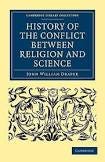
Draper, John William. History of the Conflict Between Religion and Science. New York: D. Appleton, 1874.
The founding statement of the “conflict thesis.” Writing just after the First Vatican Council, Draper cast the history of science as a war between the “expansive force of the human intellect” and “traditionary faith,” aiming his fire chiefly at Roman Catholicism. It is the urtext everything below corrects. Free at the Internet Archive.
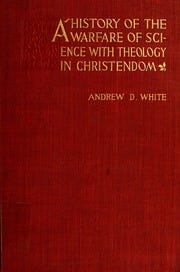
White, Andrew Dickson. A History of the Warfare of Science with Theology in Christendom. 2 vols. New York: D. Appleton, 1896.
The other, more influential classic of the “warfare” narrative. White — Cornell’s first president — catalogues case after case of “dogmatic theology” obstructing science, while carefully distinguishing that dogmatism from religion itself, which he expected to flourish once the fighting stopped. Free at the Internet Archive.
The historians’ correction
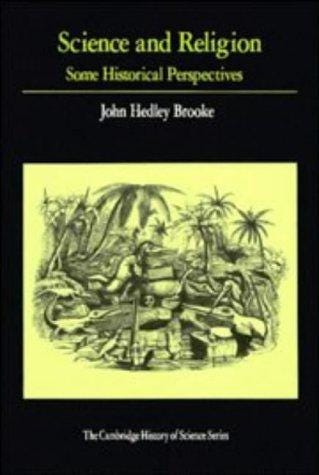
Brooke, John Hedley. Science and Religion: Some Historical Perspectives. Cambridge: Cambridge University Press, 1991.
The book that named the alternative — the “complexity thesis.” Brooke shows the real record is far too varied to fit any single slogan, whether “conflict” or “harmony,” and it remains the standard scholarly correction to Draper and White. Available at Cambridge University Press.
Numbers, Ronald L., ed. Galileo Goes to Jail and Other Myths about Science and Religion. Cambridge, MA: Harvard University Press, 2009.
Twenty-five historians each dismantle one popular myth — that Galileo was tortured, that medieval Christians taught a flat earth, and more — collectively retiring the Draper–White conflict thesis in favor of the evidence. The most accessible entry point on this list. Available at Harvard University Press.
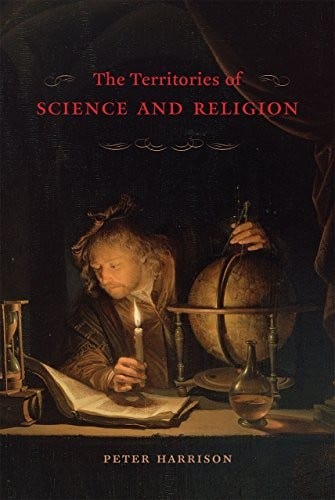
Harrison, Peter. The Territories of Science and Religion. Chicago: University of Chicago Press, 2015.
Harrison’s Gifford Lectures push deeper still: “science” and “religion” as we now use the words are barely three centuries old. Tracing the Latin scientia and religio from inner virtues to bodies of doctrine, he shows the very categories that could “go to war” are recent Western inventions. Available at University of Chicago Press.
The map itself
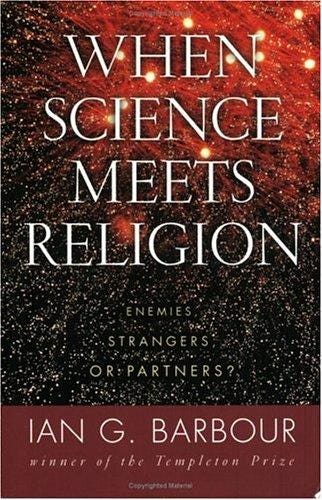
Barbour, Ian G. When Science Meets Religion: Enemies, Strangers, or Partners? San Francisco: HarperSanFrancisco, 2000.
The source of the fourfold map used in this post — Conflict, Independence, Dialogue, Integration. The physicist-theologian lays out the four postures and applies them across astronomy, quantum physics, evolution, and neuroscience. The clearest one-volume orientation to the field.